
Facial Reconstruction Gallery

This is a patient in her seventies who suffered a severe case of Bell’s Palsy on the left. You can see how her face is drooping on her pre-operative views. One of the problems that patients get with Bell’s Palsy that their eye doesn’t close. Additionally, the lower eyelid droops which causes excessive tearing and irritation of the eye. On the second set of pictures, you can still see her eyeball when she is asked to close her eye.
This patient was referred to Dr. Schmidt for ringing in her ear, but immediately we recognized that she needed surgery to help her eye. Dr. Schmidt placed a gold weight in her eyelid so it could close. He tightened her lower eyelid to prevent sagging. He then did a one-sided brow lift to help the droopiness of her upper face and improve her field of vision.
The post-operative photos were taken four weeks following her last procedure. She was extremely pleased with the result. The eye irritation and tearing improved immediately and she was extremely pleased that she could start to look more like herself.

This patient in her mid-sixties had a morpheaform basal cell carcinoma at the junction of her upper lip and her nose. Because of the location of the tumor and the kind of tumor it was, we referred her to have the lesion removed using Mohs technique. The resulting defect encompassed a portion of her right upper lip and the base of her nose. The defect was closed in the office using a flap from her upper lip and a skin graft. The result is shown without makeup at four weeks post-op.
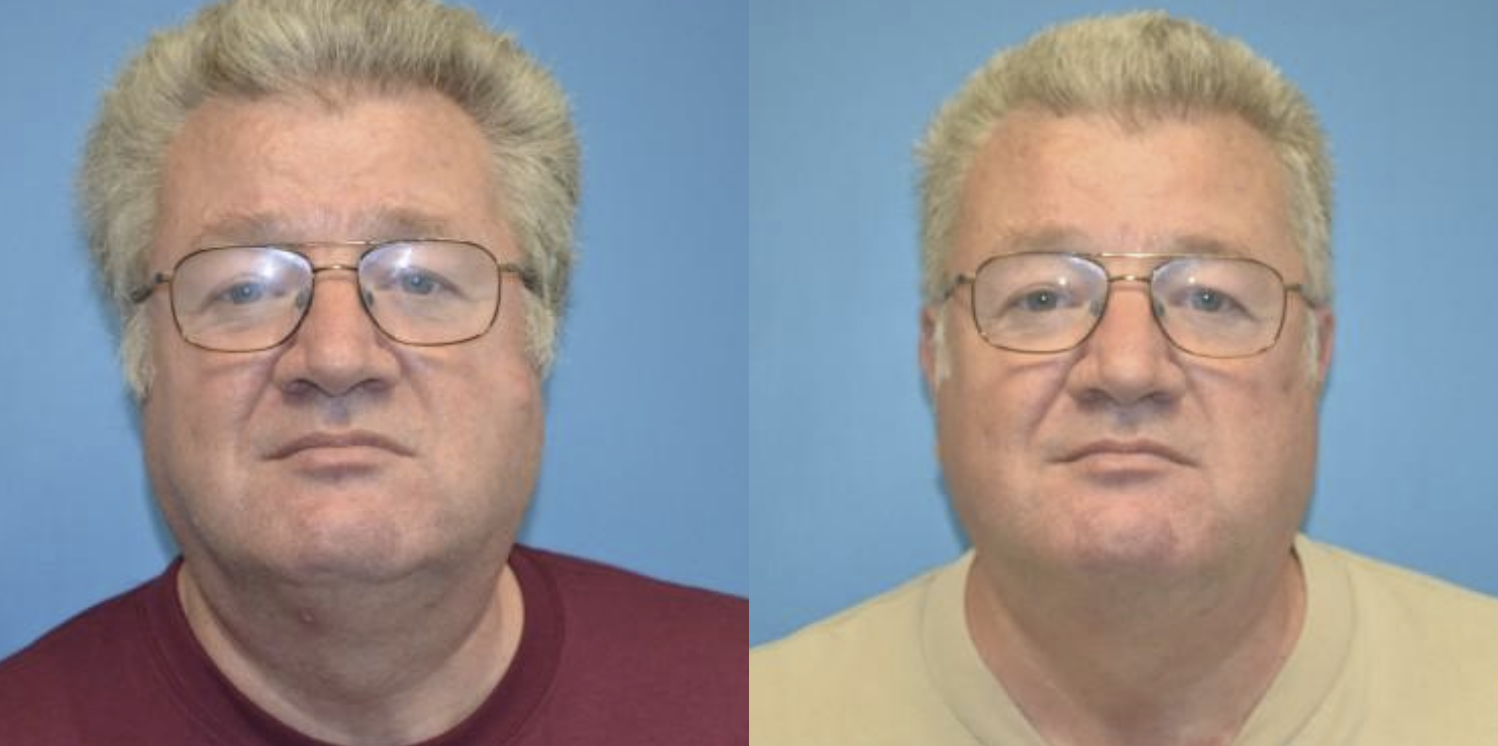
This patient in his fifties had developed a large lipoma in the middle of his left cheek. It previously had been removed by another provider, but it recurred. We removed it in the office with local anesthesia. His post-operative photos were taken a month after his procedure.

Here we have a younger patient with left-sided Bell’s palsy. Bell’s palsy is paralysis of the facial nerve from an unknown cause. As you can see, she has a few problems. The most pressing is that she can’t close her eye. She’s not winking; that’s what happens when you ask her to close her eyes. When you can’t blink or otherwise close your eye, the eye dries out and is prone to injury. It’s very uncomfortable! We performed a gold weight procedure to allow her to close her eye again.
Eyelid opening and closing comes from a balance between muscles that open the eye and muscles that close the eye. The muscles are controlled by different nerves. The closing muscles are controlled by your facial nerve. When you wish your eye to be open, the opening muscle fires, the closing muscle relaxes, and your eyelid opens. When you want your eyelid to close, the closing muscle fires and the opening muscle relaxes.
In this case, her closing muscle doesn’t work. When her brain tells her eye to close, the opening muscle relaxes normally, but her eye doesn’t close because the closing muscle doesn’t fire. We place a weight into the eyelid under local anesthesia in the office to make the eyelid heavier. When the opening muscle relaxes, gravity takes over and pulls the eyelid shut. The weight is light enough that the opening muscle can still pull the eyelid open when she desires. The scar is invisible when the eye is open. If the paralysis resolves we can remove the weight if the patient desires.

This patient suffered a rare complication from a severe frontal sinus infection. Tiny veins communicate from your frontal sinus to the skin of the forehead. Her infection traveled along one of these veins, creating an abscess. Successful treatment of the abscess by another surgeon resulted in this hole that connects her frontal sinus with the outside world. She could literally blow air out of her forehead. She had to walk around with a bandaid over the hole to make her presentable in public. Months passed before she came to my attention.
We repaired the defect in the operating room with the patient under anesthesia. We excised the borders of the defect along with tissue above and below the defect. Then, we brought the sides of her forehead together so that he had a vertical scar in the center of her forehead. Postoperative photos were taken six weeks following the surgery. No revision procedures were necessary.
A colleague and I presented this work at the AAFPRS annual meeting in New Orleans in 2013.

Here we have a patient in her seventies who had developed a pigmented lesion on her right cheek. Our initial biopsies suggested a benign lesion, but she wanted it removed. We removed it in the operating room and, after the pathologist checked the margins, repaired it using tissue rotated in from her cheek. Her scars are barely visible one year later. No revision procedures were performed.

Office Hours
Monday: 9:00 am - 5:00 pm
Tuesday: 9:00 am - 5:00 pm
Wednesday: 9:00 am - 5:00 pm
Thursday: 9:00 am - 5:00 pm
Friday: 9:00 am - 5:00 pm
CLOSED ON SATURDAY & SUNDAY